Enterprise ERP System
Optimizing Large-Scale Business Operations
Key Results
Project Highlights
1Project Overview
This enterprise ERP system serves as the operational backbone for an automotive parts distribution company, centralizing complex business processes across multiple departments and locations. The system manages the complete business lifecycle including quote generation, sales order processing, multi-warehouse inventory management, payment processing with multiple gateways, and integration with external systems like CRM platforms, accounting software, and shipping providers. Key Challenges Addressed: - Centralized management of complex automotive parts inventory across multiple warehouses - Automated order processing and fulfillment workflows - Multi-currency pricing and cost management (GBP, USD, EUR, JPY, CNY) - Real-time reporting and analytics for business intelligence - Legacy system maintenance while implementing modernization improvements
2System Architecture
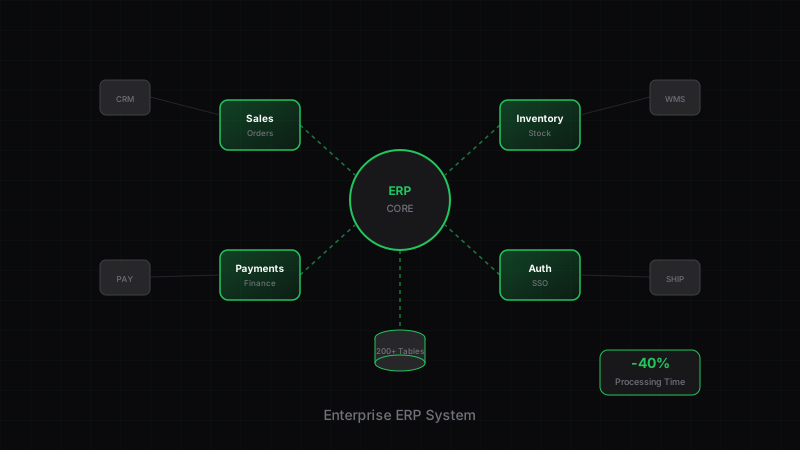
The ERP system follows a modular architecture with clear separation of concerns, enabling independent development and maintenance of each business domain.
Core Modules
- Authentication Module: SSO integration, multi-factor authentication, role-based access control
- Sales Module: Quote management, order processing, customer relationship management
- Inventory Module: Multi-warehouse stock tracking, allocation algorithms, purchase order management
- Payments Module: Multi-gateway integration, payment allocation, reconciliation automation
External Integrations
- Single Sign-On (SSO) provider for secure authentication
- CRM system for customer and deal management
- Multiple payment gateways for transaction processing
- Shipping providers for logistics and tracking
- Warehouse management systems for stock synchronization
- Accounting software for financial data export
3Technical Challenges & Solutions
Challenge 1: Legacy Codebase Navigation
Working with 200+ database tables without foreign keys and minimal documentation required developing systematic approaches to understand complex interdependencies.
Solution: Created comprehensive documentation of system relationships, used advanced code search tools to map dependencies, and built understanding through incremental, well-tested changes.
Challenge 2: Performance Optimization
Critical data processing jobs were taking 110 minutes to complete, impacting business operations.
Solution: Analyzed query execution plans, optimized database queries with proper indexing, eliminated N+1 query problems, and implemented memory-efficient batch processing. Result: 40% reduction in execution time.
Challenge 3: Complex Stock Allocation
Allocating stock across multiple warehouses with priority rules while maintaining data consistency during concurrent operations.
Solution: Developed sophisticated allocation algorithm with priority-based warehouse selection (Fast Track > Nearest > Lowest Cost), handled edge cases for partial allocations and backorders.
Challenge 4: Payment Gateway Migration
Migrating to a new payment gateway without service interruption for ongoing transactions.
Solution: Planned migration with comprehensive rollback strategy, implemented feature flags for gradual rollout, maintained backward compatibility during transition. Executed with zero downtime.
4Key Implementations
Query Optimization
Replaced inefficient N+1 query patterns with optimized JOINs, reducing query counts from 1000+ to single queries for processing 500 orders. Added composite indexes on frequently queried columns and implemented query result caching.
Stock Allocation Algorithm
Implemented priority-based allocation system that: 1. Identifies available stock across all warehouses 2. Applies priority rules (Fast Track stock first, then nearest warehouse, then lowest cost) 3. Handles partial allocations when full quantity unavailable 4. Creates backorders for remaining quantities 5. Maintains data consistency during concurrent allocations
Payment Processing
Built comprehensive payment allocation system using FIFO (First In, First Out) strategy: - Automatically allocates payments to outstanding invoices - Handles partial payments and overpayments - Creates credit balances for excess payments - Integrates with multiple payment gateways seamlessly
Memory Management
Optimized long-running processes by: - Processing data in batches instead of loading all at once - Implementing proper variable cleanup - Using generators for large dataset iteration - Optimizing array operations for memory efficiency
5Results & Impact
Performance Improvements
- 40% reduction in critical data processing pipeline execution time (110 min → 66 min)
- 77% reduction in database queries (15,000+ → 3,500)
- 52% reduction in peak memory usage (2.5 GB → 1.2 GB)
- 73% reduction in query execution time (45 min → 12 min)
- 60% reduction in CSV generation time (20 min → 8 min)
Business Impact
- Improved order processing efficiency enabling faster customer service
- Enhanced inventory visibility across all warehouses
- Streamlined payment processing with multiple gateway support
- Better financial reporting and reconciliation accuracy
- Increased system reliability and uptime
Code Quality
- Refactored thousands of lines of legacy code
- Improved error handling across all modules
- Enhanced documentation and code structure
- Standardized patterns for future development
6Lessons Learned
Working with Legacy Systems
- Systematic approach and patience are essential when navigating undocumented codebases
- Understanding business logic is as important as technical skills
- Thorough impact analysis prevents unintended consequences
- Incremental improvements are safer and more sustainable than large rewrites
Performance Optimization
- Query optimization can yield significant improvements with relatively small changes
- Memory management is crucial for long-running processes
- Profiling helps identify real bottlenecks vs. perceived ones
- Small optimizations compound into large gains over time
Integration Best Practices
- Third-party APIs require robust error handling and retry mechanisms
- Migration planning is critical for zero-downtime deployments
- Testing across all integration points is essential before production
- Comprehensive documentation aids future maintenance and onboarding
Interested in Similar Solutions?
I'm always excited to discuss complex technical challenges and how to solve them. Whether you need performance optimization, system architecture, or full-stack development, let's connect!